| Condition | Good |
|---|---|
| Format | Velin Paper "Vélin" ; is French for wove paper. It's made on a mould with a finely woven wire mesh, so the sheet comes out smooth and even, with no visible pattern when you hold it up to the light. |
| Dimensions | 17.3 cm wide × 11.3 cm tall |
| Year | 1970 |
| Artist | Picasso |
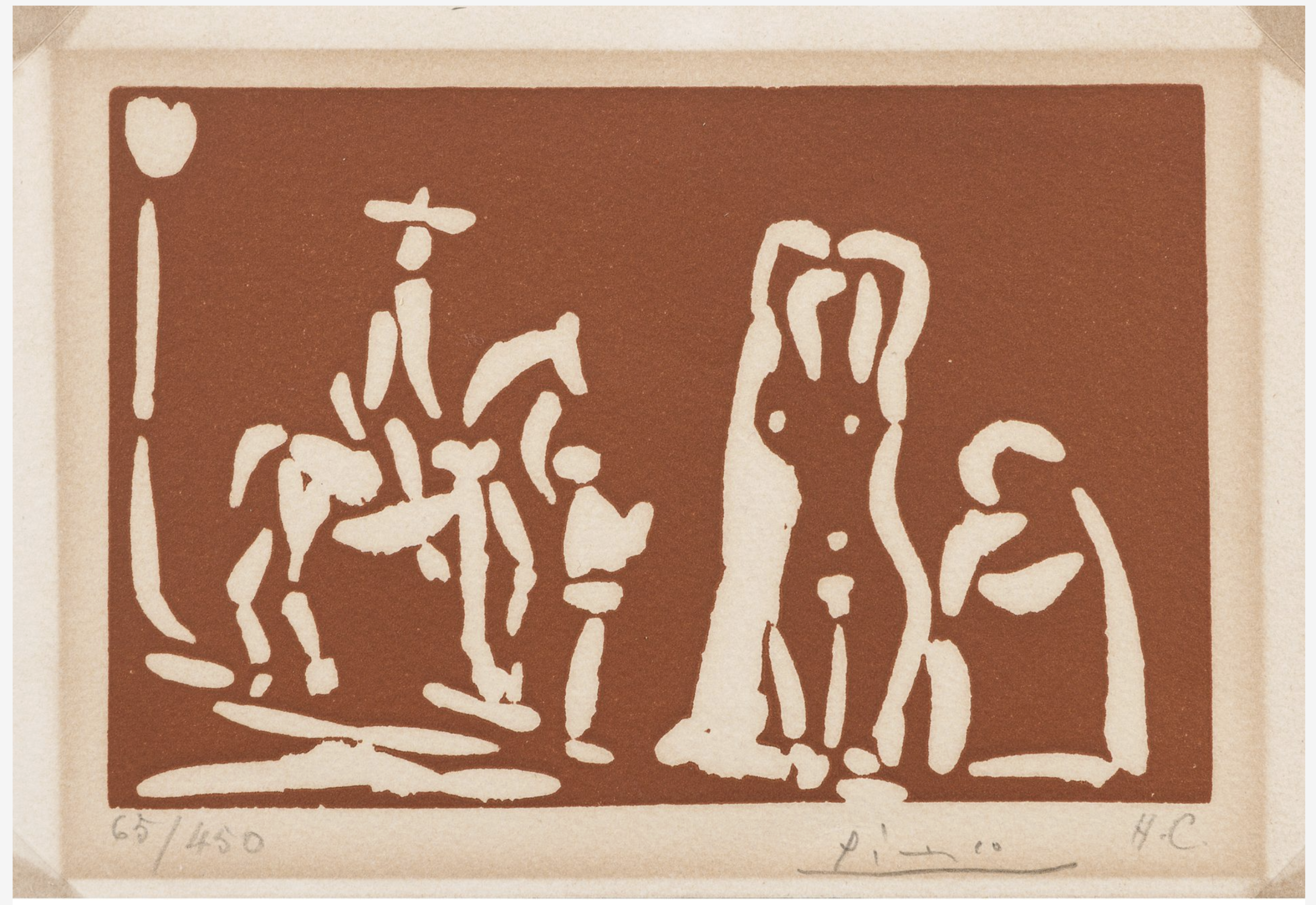
PICASSO Linocut from 1970 for Madoura
La Célestine with a woman, a horseman and his valet. 15 November 1968. Linocut. 173 × 113 mm. Bloch 1462; Baer 1854. Printed in brown. A fine impression from the edition issued as a greeting card for Madoura for 1970, on folded wove paper with printed text inside, signed in pencil, numbered and annotated “H.C.” Strong discolouration at the mount’s window opening and in the corners, as well as on the back cover, with a small strip of gummed paper tape at the top of the back.
It’s a small folded card, not a poster. It’s 17.3 cm wide × 11.3 cm tall (Ader gives width first). It was printed as a New Year card for 1970 for Madoura, the pottery workshop in Vallauris where Picasso made his ceramics. It opens like a card, with printed text inside.
Linocut, printed in brown. Picasso carved the design into linoleum and printed it from the block. It’s an original print, not a photographic reproduction.
The subject. Célestine is the old go-between from the Spanish classic La Celestina. She shows up often in Picasso’s late prints from 1968, usually setting up romantic intrigues between young women and cavaliers.
Bloch 1462 / Baer 1854. These are its numbers in the two standard catalogues of Picasso’s prints. Quote them in any listing, because they’re how dealers and buyers identify the exact print.
Signed, numbered, “H.C.” H.C. stands for hors commerce, “not for sale.” It means the impression was set aside outside the regular commercial edition, often for the artist, publisher or friends. Combined with the provenance below, this one likely came to Clergue that way.
Condition. “Oxydation” here means browning or mat burn. The acidic mount it was framed in has stained the paper along the window edge and corners, and the back is also browned and has a strip of old tape at the top. These are serious but typical faults, and a paper conservator can often reduce them.
Provenance; Lucien Clergue was a well-known photographer from Arles, a close friend of Picasso for decades, and a founder of the Rencontres d’Arles photo festival. The card was shown in a museum exhibition about their friendship, which adds credibility and interest.